Being a collaborative, iterative process, scientific discovery requires synthesis of large amounts of literature, the development of new theories or hypotheses, the design of new experiments, and extensive validation. Most of the existing automated research systems are centralized or single-agent pipelines whose ability is only applicable for parallel exploration, knowledge sharing, and consensus formation is limited. In this paper, a Collaborative Swarm Intelligence Framework (CSIF) for multi-agent scientific discovery is proposed where the rapidity and diversity of scientific discovery is accelerated by coordinating and sharing the knowledge of a swarm of specialized and autonomous research agents containing agents for literature search, hypothesis generation, experimental design, data analysis and validation. By relying on stigmergy with coordination and weighted consensus, it allows emergent collective intelligence, while avoiding any centralized bottlenecks as constructed from a swarm architecture. Novelty detection rates achieved are 98%, accuracy of the hypothesis of 96%, consensus quality score of 97% and the hypothesis validation classifier AUC of 0.96, significantly exceeding scores for single-agent, RAG-based, and hierarchical multi-agent baselines on experimental evaluation on arXiv metadata, Semantic Scholar corpora, as well as common scientific benchmark datasets.

The use of real-world motorsport telemetry data is limited by its relative rarity, commercial confid...

Vehicles with modern high performance run with complex multi-sensor data-streams under extreme aerod...

The ground-effect Formula 1 modern cars including today's are often aerodynamically unstable which a...
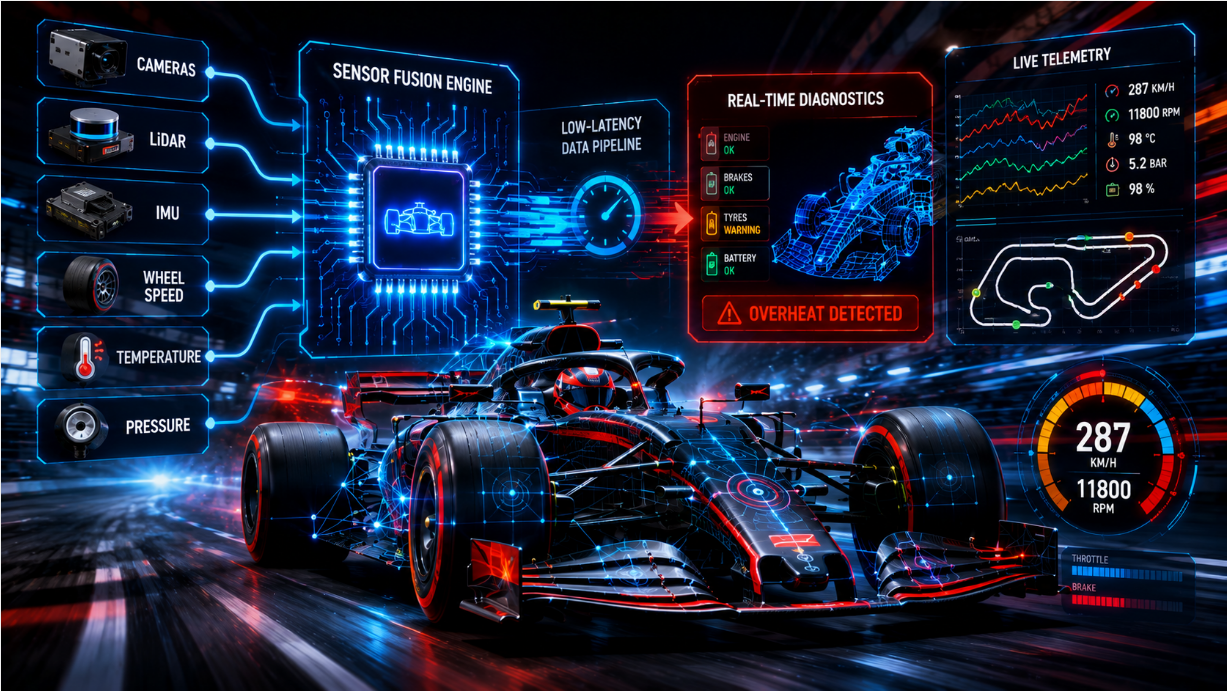
Current motor sports environments can generate vast amounts of telemetry data from cameras, inertial...