One of the key architectural challenges is the inability of current transformer-based models to retain information from previous conversations or tasks beyond their maximum 'context window' of tokens, which prevents them from leveraging the information that has been generated. A major architectural challenge is the need for existing transformer-based models to retain information from previous conversations or tasks beyond a maximum 'context window' of tokens, which prevents them from utilizing the information that has already been generated. This restriction is extremely restrictive on the ability of either multi-session agents, or longitudinal user interactions, or complex reasoning chains of autonomous agents that need coherent access to events that are separated by thousands of tokens or many conversational turns. In this paper we propose a new architecture called Adaptive Memory-Augmented Agentic System (AMAS) that combines an agentic design with short-term memory and long-term memory modules and allows for arbitrarily long interaction horizon with the preservation of the contextual fidelity by using a dedicated memory retrieval agent operating on the adaptive relevance scores. The architecture of AMAS breaks down memory into four stages: acquisition, encoding, retrieval, and adaptive update, which is controlled by a mathematically principled relevance-weighted memory consolidation scheme. AMAS also outperforms standard LLM baselines by 20 and 25 percentage points on context accuracy and memory retention respectively, on the LongBench benchmark, multi-session conversational datasets and Natural Questions, while maintaining competitive latency at 1,500ms end-to-end.
Keywords : Agentic AI, LLM , Retrieval-Augmented Generation, Vector Databases, Spiking Neural Networks.
Authors : Kuppireddy Krishna Reddy , Teklu Urgess
Title : Adaptive Memory-Augmented Agentic Systems for Long-Term Context Preservation in Large Language Model Environments
Volume/Issue : 2026;3(2 ( April - June ))
Page No : 30 - 36

 ISSUE: Volume 3 (2026) , Issue 2 ( April - June )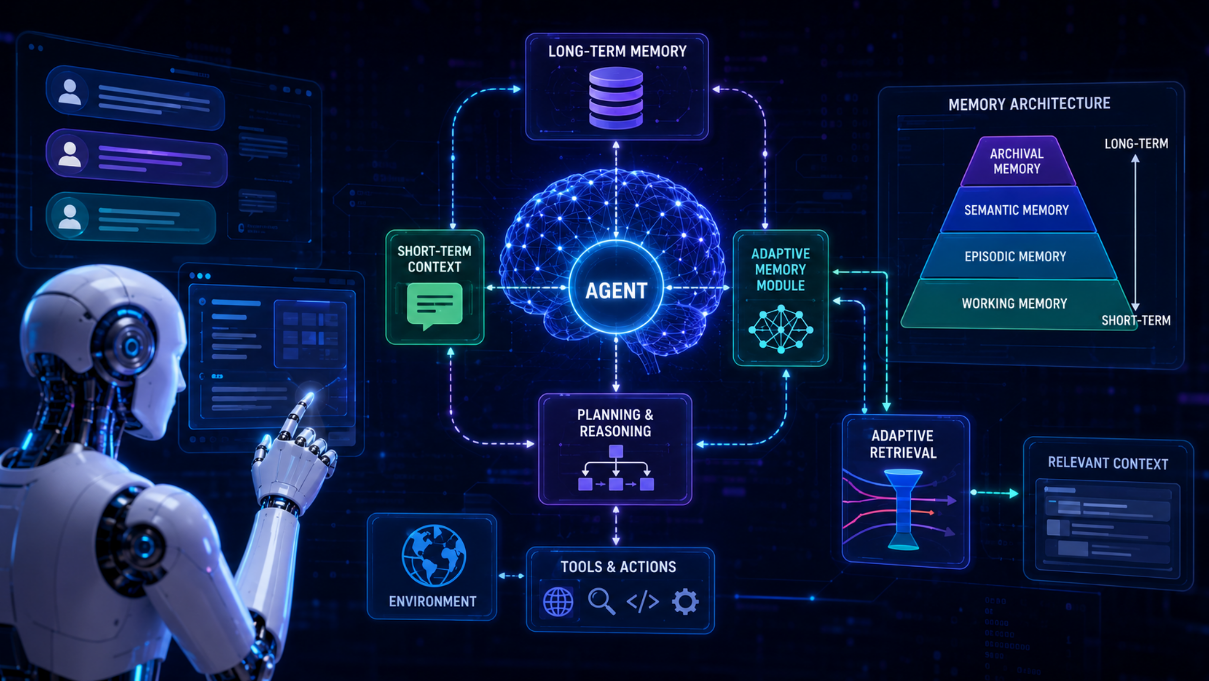




 Cover Page



 Manuscript Status